Security lessons from the United States are shaping how Canadian jewellery stores prepare for theft, according to observations made at the 42nd Annual Security Seminar and Expo hosted by Jewelers’ Security Alliance (JSA). The event highlighted tactics that mirror recent Canadian incidents, prompting industry leaders to reconsider entry control, exterior monitoring and device jamming.
Entry control and vehicle attacks
One case shown at the seminar involved thieves arriving in stolen cars, ramming a storefront and smashing display cases. The victim, an elderly shop owner, suffered a stroke after being pushed to the ground. Although the store had a controlled-access door, a panicked employee unintentionally released the lock, allowing the criminals inside.
The incident shows two priorities: limit access points and train staff to respond calmly. In the United States, similar assaults have been carried out with 4,000-lb vehicles, and traffic bollards remain the most reliable barrier. Modern bollard designs can blend with streetscapes, so retailers are no longer confined to utilitarian cement pillars.
Exterior AI monitoring
Traditional alarm systems only react after a breach, but new AI-driven units can intervene earlier. Mat Smitheman of Interface demonstrated a solar-powered exterior module that watches for loitering and issues pre-recorded warnings. If the behavior persists, the system routes live video to a monitoring centre where an operator can speak through a built-in two-way device.
This proactive approach mirrors a shift seen in other high-risk retail sectors, where early detection has reduced forced entries. The technology’s reliance on a single power source also addresses concerns about power outages during emergencies.
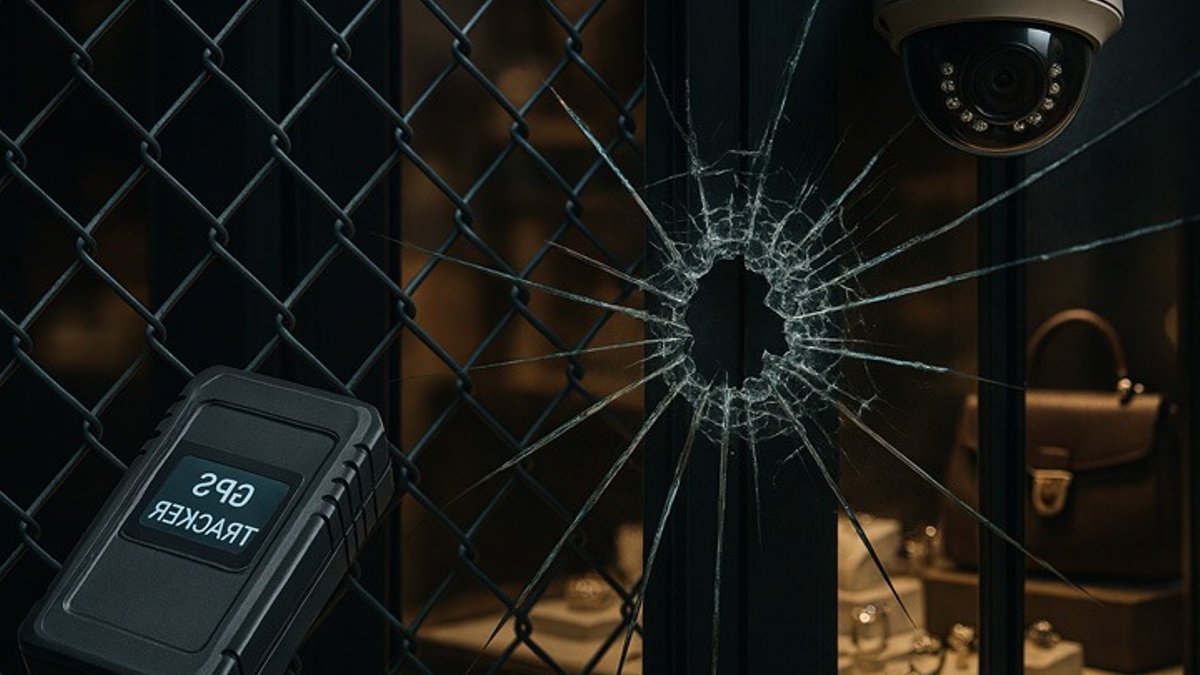
Embedding GPS trackers in high-value items offers another layer of protection. Dan Kopchick of Ensurity described devices that can be sewn into jewellery pillows and display boxes, transmitting location updates roughly every 20 seconds. Battery life reaches six months on standby and three weeks while actively sending data, providing ample time for recovery.
Related Post: Canadian jewellery industry fights tariffs and rising gold
While consumer-grade trackers such as Apple AirTags have seen limited success, they lack real-time precision and can be easily spotted, reducing their effectiveness for professional loss-prevention programs.
Organized crime groups are also evolving their methods, sometimes entering through roofs after conducting prior construction work. They may deploy jamming tools to disrupt wireless alarm signals. DGA Security’s Jam Guard detects such interference and alerts the monitoring centre, giving owners a chance to respond before thieves reach the safe.
Regular maintenance remains essential: annual alarm inspections, quarterly tests and updated contact lists can prevent missed alerts. In both the United States and Canada, outdated key-holder information often leads to unanswered alarms, undermining response efforts.
Compared with past decades, when most jewellery thefts involved simple smash-and-grab tactics, today’s criminals employ sophisticated planning and technology. The transition mirrors broader trends in organized crime, where digital tools augment physical force, raising the stakes for retailers who must now defend against both brute and cyber-enabled threats.
Industry groups such as Jewellers Vigilance Canada, a non-profit arm of the Canadian Jewellers Association, continue to collaborate with law-enforcement agencies to disseminate these findings and promote best practices across the sector.


